
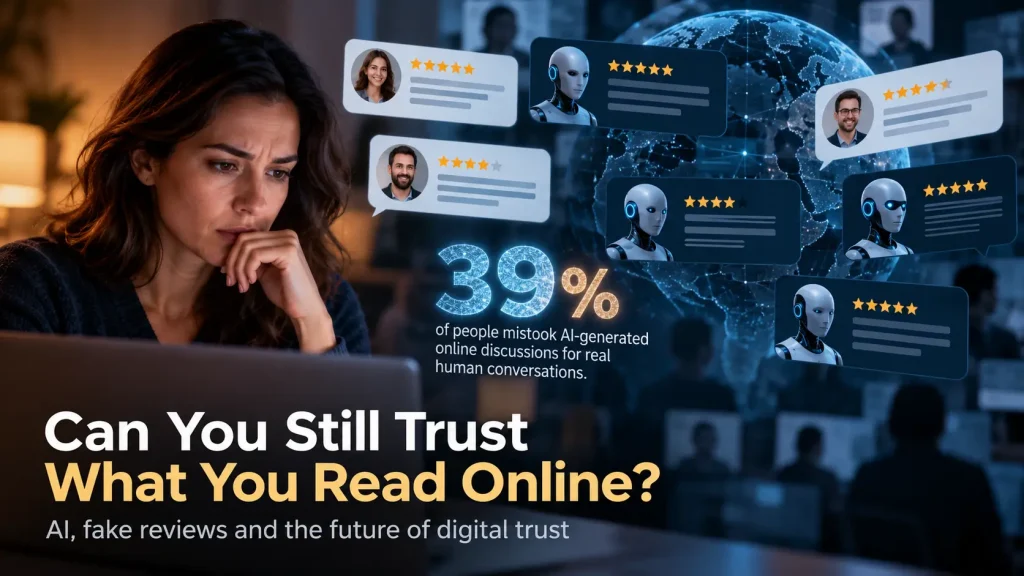
Can You Still Trust What You Read Online? AI, Fake Reviews and the Future of Digital Trust
Artificial intelligence is making online conversations more convincing than ever. But when comments, reviews and even apparent customer experiences can be created automatically, how do we know whom to trust? And what does this mean for businesses trying to build genuine relationships with their customers?
Imagine a Conversation That Never Really Happened
You are considering buying a new product. Before making a decision, you check the comments beneath a Facebook post. One person recommends it enthusiastically. Another asks whether it is worth the price. A third shares a detailed experience, mentioning both advantages and a few minor disadvantages.
It sounds like a normal discussion but what if none of those people actually exists? What if the entire conversation: the questions, answers, disagreements and personal stories was generated by artificial intelligence? This isn’t simply a scene from a science fiction film. The technology needed to create convincing artificial conversations already exists and it raises a question that is becoming increasingly important for consumers and businesses alike:
If anyone can create the appearance of public opinion, how do we decide what deserves our trust?
How Convincing Has AI Become?
In July 2026, researchers published an interesting study in Scientific Reports titled The Collective Turing Test: Large Language Models Can Generate Realistic Multi-User Discussions. The researchers compared genuine Reddit conversations with artificial discussions generated by large language models.
When participants were shown human and AI-generated conversations side by side, they mistook AI-generated discussions for human conversations 39% of the time.
For one of the models tested, participants correctly identified artificial discussions only 56% of the time barely better than guessing.
These findings don’t mean that 39% of online conversations are artificial. The study examined people’s ability to recognise AI-generated discussions under experimental conditions, so what it does demonstrate is that artificial conversations can be remarkably convincing and when a single system can generate multiple voices, the possibilities extend well beyond writing a simple chatbot response.
Read the research published in Scientific Reports, July 2026
Is the Internet Already Full of Bots?
Another interesting finding comes from the 2026 Thales Bad Bot Report.
According to Thales’s analysis of 2025 traffic, automated systems accounted for 53% of observed internet traffic, with 40% classified as malicious bots. That sounds extraordinary, but the figures need some explanation. Internet traffic includes much more than people reading websites or commenting on social media. Search engine crawlers, monitoring systems, automated data collection tools and many other services also generate traffic.
So the figures do not mean that half of all internet comments, reviews or social media accounts are fake.
Nevertheless, they illustrate how much of today’s digital activity already happens without direct human involvement. The internet is no longer simply a place where people communicate through computers. Increasingly, it is also a place where software communicates with other software.
Explore the 2026 Thales Bad Bot Report
When One Person Can Look Like a Thousand Customers
Let’s consider a practical example and imagine an unfamiliar online shop advertising a product.
It has hundreds of enthusiastic reviews. Customers appear to be discussing delivery times, product quality and customer service. Some reviews include detailed personal stories so you might reasonably assume that the business is popular and established. But with generative AI, creating hundreds of unique comments no longer requires hundreds of people.
A dishonest operator could generate reviews in different writing styles, create imaginary experiences and organise conversations between supposedly independent accounts.
This is a modern form of an older practice known as astroturfing, in other words creating the appearance of genuine public support where it may not exist. The consequences extend beyond shopping.
Similar tactics can be used to promote questionable investments, influence discussions or make a poorly established business appear more reputable than it really is.
A thousand positive comments are not necessarily evidence of a thousand satisfied customers.
That doesn’t mean we should stop reading reviews. It means we need to become more careful about what those reviews actually prove.
There Is a Difference Between an AI-Written Review and a Fake Review
This distinction is particularly important, and it is often overlooked. Imagine you recently stayed at a hotel in Cyprus and you enjoyed your visit, but English isn’t your first language. You ask an AI assistant to help you write a clear, polite review describing your experience. The final review is AI-assisted, but the experience is genuine.
Now imagine someone who has never visited that hotel generating twenty glowing reviews describing imaginary stays. Both examples involve AI. But they are fundamentally different.
In the first case, AI helps a real customer communicate. In the second, it creates evidence of a customer experience that never happened. The technology itself isn’t the deciding factor.
What matters is whether the experience is genuine, whether the information is accurate, and whether the reader is deliberately being misled.
For business owners, this is a particularly useful principle. Using AI to improve communication is not the same as using AI to manufacture a reputation.
What Happens When AI Starts Learning from AI?
There’s another challenge that deserves attention. More people are using AI assistants to find information instead of visiting several websites and comparing sources themselves but where does that information come from? Much of it originates from material already published online.
Suppose an AI-generated article contains an incorrect claim. Other websites repeat it. More articles appear, perhaps with slightly different wording and eventually, a search engine or AI assistant may encounter several sources making the same claim.
To a casual reader, the information might appear well established but repetition does not make something true. A related technical concern was explored in research published in Nature in 2024. The researchers demonstrated that indiscriminately training AI models on recursively generated data can damage their performance, a phenomenon known as model collapse.
This doesn’t mean every AI answer is becoming less reliable. It does demonstrate why the quality and origin of information matter. For businesses publishing articles, guides and advice, the lesson is straightforward: adding more content to the internet is not necessarily the same as adding more value.
Google’s own guidance encourages publishers using generative AI to focus on accuracy, quality, originality and relevance rather than producing large quantities of low-value pages.
In other words, AI can help us publish faster. It cannot replace responsibility for what we publish.
Why Digital Trust Matters for Businesses in Cyprus
For a small or medium-sized business, reputation has always been important. A recommendation from a satisfied customer, a helpful conversation or a positive personal experience can make a real difference.
But today’s customers often meet a business online long before they speak to anyone who works there. They encounter the company through its website, Google results, social media posts, customer reviews or answers generated by AI-powered search tools and those first impressions influence whether people continue exploring or move elsewhere but now consider the challenge.
If customers become increasingly suspicious of online content, even genuine businesses may find it harder to demonstrate their credibility.
For example:
- A new Cyprus-based consultancy may struggle to distinguish its genuine expertise from polished, automatically generated claims;
- A local retailer may compete against sellers displaying fabricated reviews and artificial popularity;
- A hotel or service provider may find that authentic customer testimonials receive the same initial scepticism as suspicious ones;
- A professional organisation may need to demonstrate clearly who is responsible for its advice, information and decisions.
These are not reasons to abandon digital marketing but quite the opposite.
They suggest that trust should become part of a company’s digital strategy, not simply something left to customer reviews or marketing slogans.
Europe Is Already Addressing AI Transparency
The European Union has begun introducing specific transparency obligations under the EU AI Act.
Article 50 applies from 2 August 2026, with a limited transitional period for certain AI-content marking obligations. Among other requirements, it addresses transparency when people interact directly with AI systems, the identification of certain AI-generated content, and disclosure requirements relating to deepfakes and particular public-interest publications. The obligations depend on how the technology is used, the role of the organisation and the applicable exceptions. This does not mean every business must label every piece of writing that has been improved with AI.
However, the direction is significant: people should be able to understand when they are interacting with artificial intelligence in circumstances covered by the rules.
Separately, existing EU consumer protection rules already prohibit businesses from submitting or commissioning fake consumer reviews and impose requirements concerning claims that reviews come from genuine customers.
For a Cyprus-based business, these requirements are relevant because Cyprus operates within the same European regulatory framework.
Transparency is therefore becoming both a matter of customer confidence and, in relevant circumstances, legal compliance.
European Commission: AI transparency obligations
Your Europe: Unfair commercial practices and fake reviews
How Can a Small Business Build Trust Without a Big Budget?
The encouraging news is that trustworthy communication doesn’t necessarily require sophisticated technology or expensive marketing campaigns.
For many small businesses, the starting point is simply becoming more transparent, consistent and accountable.
Show the people behind the business.
Give customers a clear picture of who you are, what you do and how they can contact you. Real team information, professional backgrounds and identifiable contact details help people understand who is responsible for the business.
Demonstrate experience instead of making broad promises.
Rather than saying your company provides excellent service, explain how you solved a particular problem. A genuine case study, a practical guide or an honest explanation of a completed project can be more persuasive than a page full of promotional claims.
Treat customer reviews responsibly.
Encourage genuine feedback and avoid invented testimonials. When responding to criticism, address the concern rather than simply trying to protect a perfect rating. Where appropriate, use review services that support verified customer experiences.
Be clear about how AI is being used.
An AI-powered customer service assistant can be extremely helpful. But there is little benefit in deliberately making customers believe they are speaking to a human employee when they aren’t. A simple explanation that an assistant is AI-powered can set appropriate expectations.
Publish useful information that can be checked.
Support important claims with credible sources. Update outdated information, identify responsible authors where relevant, and distinguish verified facts from opinions or estimates.
Make privacy and security visible.
A clear privacy notice, appropriate data protection practices, secure forms and transparent handling of customer information all contribute to confidence.
These measures are not substitutes for legal compliance, but they help customers understand how the business treats their information.
Make it easy to reach a real person.
Automation is valuable, but some situations require human judgement and customers should be able to find a reasonable route to human assistance when their questions involve complaints, unusual circumstances or important decisions. None of these measures alone guarantees trust. Together, however, they help build something more meaningful than an impressive-looking website as they demonstrate accountability.
Can We Still Recognise AI-Generated Comments?
Perhaps. But we should be careful about relying on our instincts alone as artificial writing is sometimes described as unusually polished, repetitive or lacking personal detail. The difficulty is that real people can write like that too. AI systems can also use informal language, humour, spelling mistakes and everyday expressions rather than concentrating entirely on writing style, it is often more helpful to consider the broader context.
Does the account have a credible history? Are its claims supported by independent information? Is the review connected to a verified purchase? Are several accounts repeating suspiciously similar messages?
Even these clues are imperfect: a genuine customer might have a new account. A long-established account could be compromised.
The safest approach is not to assume that everything online is false. It is to avoid relying on a single unverified source when making an important decision and that’s where I would like to hear from you.
Your Opinion: Can You Still Trust Online Reviews?
AI is changing how we communicate, shop and make decisions online. But people may have very different views on whether this is a problem. Please take a moment to answer two questions.
Question 1: Have you ever seen an online comment or review that you suspected was written by AI?
- Yes, quite often
- Yes, occasionally
- No, I haven’t noticed any
- I’m no longer confident I can tell
Question 2: Would you trust a review less if you knew the customer used AI to help write it, but the experience described was genuine?
- Yes, I would trust it less
- No, the genuine experience is what matters
- It depends on how AI was used
- I’m not sure
Have you ever mistaken an AI-generated message for a real person’s comment? Or have you experienced the opposite? Feel free to share your thoughts in the comments.
The Future of the Internet Isn’t Just About Artificial Intelligence. It’s About Trust.
AI will continue to help businesses communicate, automate routine work, analyse information and create digital experiences.
These are genuine opportunities, particularly for smaller organisations with limited resources.
But as producing convincing online content becomes easier, creating content alone will become less of a competitive advantage.
Businesses will need to demonstrate something more substantial: real expertise, credible information, responsible behaviour and a willingness to stand behind what they publish.
Perhaps the question we should be asking is no longer simply, “Was this written by AI?”
A better question might be:
“Can I verify this information, and can I trust the person or organisation responsible for it?”
That is a question worth asking whether the content was written by a machine, a human being or both.
And for businesses prepared to answer it, digital trust may become one of their most valuable competitive advantages.
About Emersol
Emersol is about Marketing Technologies & Digital Product
We explore how digital technology, practical marketing and responsible innovation can help businesses improve their online presence, communicate more effectively and create better customer experiences.
Technology should make business relationships easier and more meaningful not less trustworthy.

Sources & Further Reading
- Bouleimen, A. et al. (2026). The Collective Turing Test: Large Language Models Can Generate Realistic Multi-User Discussions. Scientific Reports. Read the research.
- Thales (2026). 2026 Bad Bot Report: Bad Bots in the Agentic Age. View the report.
- Shumailov, I. et al. (2024). AI Models Collapse When Trained on Recursively Generated Data. Nature. Read the research.
- European Commission (2026). Transparency Obligations Under Article 50 of the AI Act. Read the official guidance.
- European Commission — Your Europe. Unfair Commercial Practices and Fake Consumer Reviews. Read the consumer guidance.
- Google Search Central. Google Search’s Guidance on Using Generative AI Content on Your Website. Read the guidance.