Key Innovations for Private Schools with Young Learners as a Part of the Latest EdTech Trends
In today’s rapidly evolving educational landscape, private schools need to embrace cutting-edge EdTech (Educational Technology) solutions to enhance learning experiences and stay ahead of the curve. While technology is reshaping classrooms across all age groups, the most effective tools for younger students – are designed to engage, inspire, and build foundational skills in a fun, interactive environment.
If you are a private school catering to younger students, understanding the latest EdTech trends and selecting the right tools can significantly improve student outcomes and keep parents invested in their child education. Here are the top EdTech trends, with a special focus on those most effective for younger learners.
Making Learning Fun and Engaging Like a Game
For younger students, learning can – and should – be fun. Gamification turns everyday lessons into interactive, game-like experiences that foster enthusiasm for subjects like math, reading, and science. Tools like Kahoot and Classcraft offer quiz-based learning and challenges that keep children engaged and motivated while promoting healthy competition and teamwork.
Integrating gamification into your private school’s curriculum can significantly enhance student participation and help young learners build foundational skills while having fun.
Implementing Hands-on Learning by Interactive Whiteboards and Displays
Young students benefit from tactile and visual learning, making interactive whiteboards a must-have in modern classrooms. Tools like SMART Boards or Promethean Displays allow students to interact directly with lessons, fostering collaboration and improving understanding of complex concepts. Whether solving math problems, exploring scientific diagrams, or reading interactive stories, whiteboards transform passive learning into dynamic classroom experiences.
For private schools that prioritize interactive, hands-on learning, investing in these tools is essential.
Enhancing Communication and Collaboration Using Cloud-Based Learning Platforms
For young learners, seamless communication between teachers, students, and parents is critical to success. Some platforms are particularly effective for younger children, offering user-friendly interfaces that allow students to complete assignments, engage with digital content, and showcase their work to parents. These platforms also make it easy for parents to stay involved, ensuring a collaborative approach to education.
By adopting cloud-based platforms, your school can foster better communication, simplify learning management, and give parents a real-time view of their child’s progress.
Building Well-Rounded Learners with Social and Emotional Learning (SEL)
Private schools that emphasize holistic education should integrate social and emotional learning (SEL) tools into their curricula. Apps like ClassDojo and Second Step are excellent for teaching young students emotional intelligence, self-regulation, and positive behavior. SEL is particularly important for students aged 5-12 as they begin to navigate social interactions and emotional challenges in school settings.
Incorporating SEL technology into the classroom helps develop well-rounded students who are equipped with both academic and social skills.
Educational Games and Applications as Playful Learning with Purpose
Educational games are a powerful way to teach younger students core subjects while keeping them engaged through play. Apps like ABCmouse and Prodigy Math are designed specifically for young learners, blending fun with foundational skill-building in literacy, math, and problem-solving. These tools make learning enjoyable and interactive, helping students retain knowledge better than traditional methods.
If your private school focuses on fostering a love for learning at an early age, educational apps are a key investment.
STEM and STEAM Education to Spark Creativity and Critical Thinking
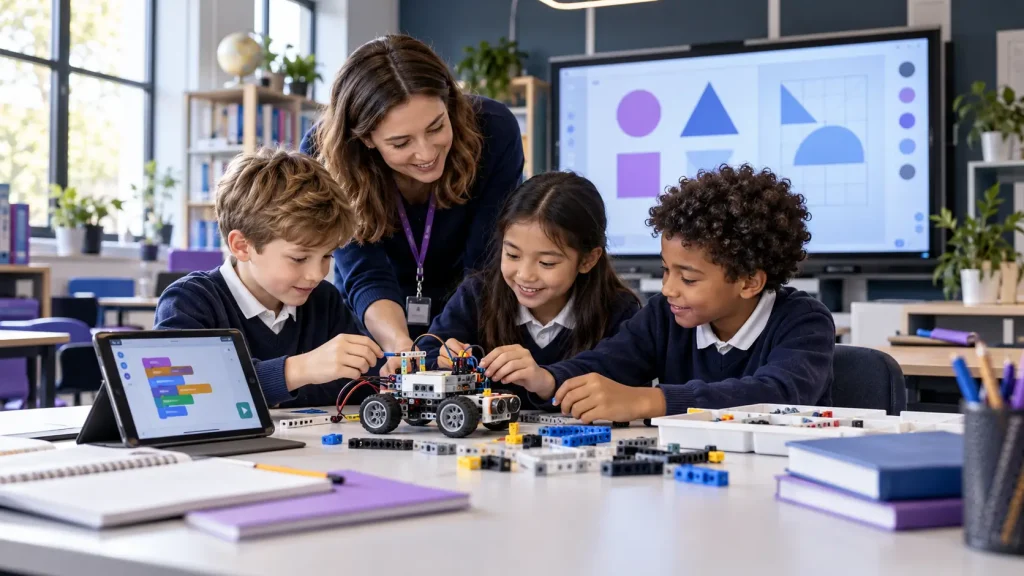
Incorporating STEM (Science, Technology, Engineering, and Math) and STEAM (adding Arts) into early education is becoming increasingly important. Tools like LEGO Education and Osmo offer hands-on learning kits and activities that help younger students develop critical thinking and creativity through building, coding, and experimenting.
By introducing STEM/STEAM learning early, your private school can equip students with essential skills for future academic success, while making problem-solving a fun and interactive experience.
Assistive Technologies to Ensure Inclusive Learning
Inclusivity is vital in today’s education environment. Assistive technologies ensure that every child, regardless of their learning style or ability, can access the curriculum. Tools like Speechify (text-to-speech) or Kurzweil 3000 (reading and writing support) are particularly useful for younger students who might struggle with reading, visual impairments, or learning differences like dyslexia.
Implementing assistive technologies helps ensure that your private school provides an inclusive learning environment where every child can thrive.
Coding and Computational Thinking by Preparing Future Innovators
Introducing children to coding at an early age is an excellent way to foster critical thinking and problem-solving skills. Tools like ScratchJr and Tynker teach younger students the basics of programming through simple, intuitive interfaces. Coding games and challenges help them understand logical processes, creative thinking, and perseverance—skills essential for the future.
Integrating coding into your private school curriculum sets a strong foundation for tech literacy, creativity, and problem-solving in young learners.
Embrace the Future of Education
For private schools with younger students, these EdTech trends offer incredible opportunities to enhance learning experiences, engage students in innovative ways, and provide a solid foundation for lifelong learning. Whether it’s gamified lessons, interactive whiteboards, or social-emotional learning tools, choosing the right technology can elevate your school’s reputation as a leader in modern education.
By embracing these age-appropriate EdTech tools, your private school can create a dynamic, inclusive, and interactive learning environment that sets young students up for success.
Ready to take your private school to the next level with cutting-edge educational technology?
Download our comprehensive checklist to assess the status of must-have and emerging EdTech in your school. This tool will help you evaluate where your school stands with key innovations such as:
- Interactive whiteboards and classroom displays
- Gamified learning tools
- Robotics and coding programs
- Social-emotional learning (SEL) tools
- STEM-focused educational kits and platforms
Find out if your school is leveraging the full potential of the latest educational technologies and what areas need to be upgraded or implemented.
📥 Download the EdTech Checklist Now and start shaping the future of education for your students!

Please do not hesitate to get in touch (WhatsApp) with us in case of questions or queries
References:
Impact of Gamification on Motivation and Academic Performance: A Systematic Review
Published in MDPI. This study examines the impact of gamification in educational settings, highlighting its influence on student motivation and academic performance. Read More
The Impact of Gamification in Educational Settings on Student Learning Outcomes: A Meta-Analysis
Published in Educational Technology Research and Development. This meta-analysis explores how gamification affects student learning outcomes across various educational contexts. Read More
Effects of Digital Game-Based STEM Education on Students’ Learning Achievement: A Meta-Analysis
Published in the International Journal of STEM Education. This study investigates the effectiveness of digital game-based STEM education on student learning achievements. Read More
Educational Robotics for Developing Computational Thinking in Young Learners: A Systematic Review
Published in TechTrends. This review focuses on how educational robotics fosters computational thinking skills among young students. Read More
Augmented Reality and Gamification in Education: A Systematic Literature Review of Research, Applications, and Empirical Studies
Published in Applied Sciences. This study examines the role of augmented reality and gamification in enhancing educational experiences and outcomes. Read More
The Effects of Gamification on Engineering Lab Activities
Eunsik, K., Rothrock, L., & Freivalds, A. (2016). IEEE Frontiers in Education Conference. This paper explores the impact of gamification on student engagement and learning in engineering lab settings. Read More
Assessing the Efficacy of Incorporating Game Dynamics in a Learning Management System
Frost, R. D., Matta, V., & MacIvor, E. (2015). Journal of Information Systems Education. This study evaluates how game dynamics integrated into LMS platforms can enhance student motivation and learning outcomes. Download
The Impact of a Forfeit-or-Prize Gamified Teaching on E-Learners’ Learning Performance
Ge, Z.-G. (2018). Computers & Education. This research investigates the effects of gamified teaching strategies on the learning performance of e-learners. Read More
Assessing the Effects of Gamification in the Classroom: A Longitudinal Study on Intrinsic Motivation, Social Comparison, Satisfaction, Effort, and Academic Performance
Hanus, M. D., & Fox, J. (2015). Computers & Education. This longitudinal study assesses the long-term effects of gamification on various student behaviors and academic performance. Read More
Engaging Asian Students Through Game Mechanics: Findings from Two Experiment Studies
Hew, K. F., Huang, B., Chu, K. W. S., & Chiu, D. K. W. (2016). Computers & Education. This study explores how game mechanics can enhance engagement and learning outcomes among Asian students. Read More
Improving Argumentative Writing: Effects of a Blended Learning Approach and Gamification
Lam, Y. W., Hew, K. F., & Chiu, K. F. (2018). Language Learning & Technology. This paper examines the impact of blended learning and gamification on students’ argumentative writing skills. Read More
Developing a Theory of Gamified Learning: Linking Serious Games and Gamification of Learning
Landers, R. N. (2014). Simulation & Gaming. This article develops a theoretical framework linking serious games and gamification in learning environments.
Read More
Visible Learning: A Synthesis of Over 800 Meta-Analyses Relating to Achievement
Hattie, J. (2008). Routledge. This comprehensive synthesis examines factors that influence student achievement, including the role of educational technologies like gamification.
Read More
Improving Sexual Health Education Programs for Adolescent Students Through Game-Based Learning and Gamification
Haruna, H., Hu, X., Chu, S. K. W., Mellecker, R. R., Gabriel, G., & Ndekao, P. S. (2018). International Journal of Environmental Research and Public Health. This study explores the use of game-based learning and gamification in improving sexual health education.
Read More
Comparing Digital Badges and Points with Classroom Token Systems: Effects on Elementary School ESL Students’ Classroom Behavior and English Learning
Homer, R., Hew, K. F., & Tan, C. Y. (2018). Educational Technology & Society. This research compares the effectiveness of digital badges and traditional token systems on student behavior and learning outcomes.
Read More
Computational Thinking in K-12 Education Through Robotics Activities: A Systematic Review
Keramopoulos, E., Diamantaras, K., Evangelidis, G. (2022). TechTrends. This systematic review analyzes how robotics activities contribute to the development of computational thinking skills in young learners.
Read More
Augmented Reality and Gamification in Education: A Systematic Literature Review of Research, Applications, and Empirical Studies
Lampropoulos, G., Keramopoulos, E., Diamantaras, K., & Evangelidis, G. (2022). Applied Sciences. This review examines the integration of augmented reality and gamification in education, highlighting their benefits and applications.
Read More