Financial wellbeing · Cyprus
Financial scams in Cyprus: recognise the signs, protect your money
An unexpected bank message. A parcel notification. An investment that sounds too good to miss. A few simple checks can help you decide what to trust—and where to get help.

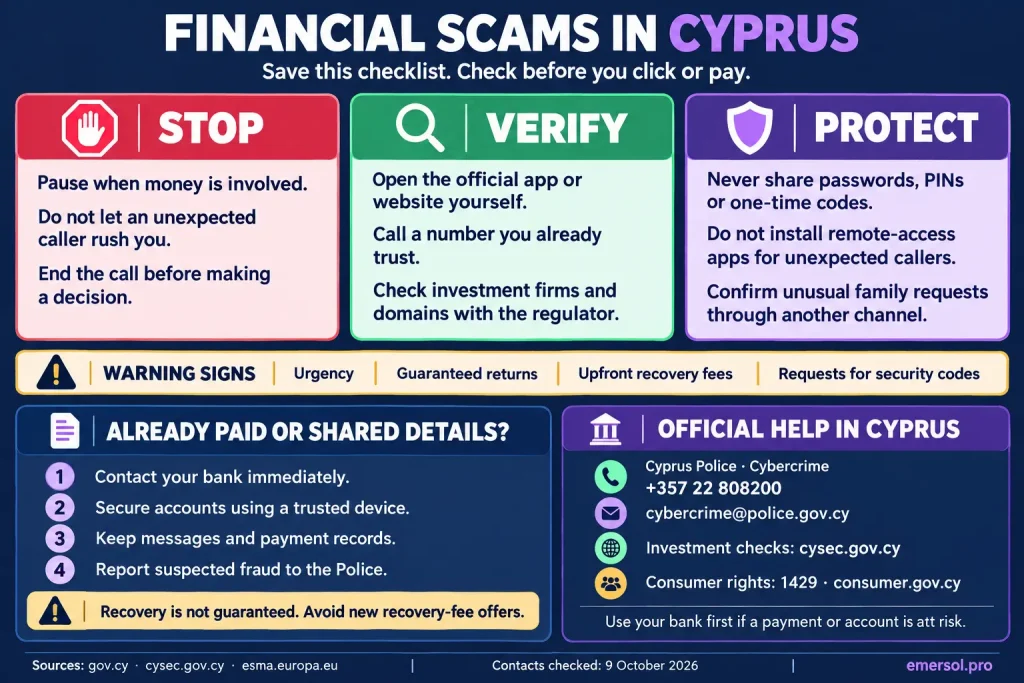
Already paid or shared banking details?
Contact your bank immediately through its official app or a trusted number. Explain what happened and ask it to protect your account and assess the payment. Keep the messages and payment records, then report the incident.
Scammers often pretend to represent organisations we already know. They may sound helpful, use familiar logos or spend time earning our trust. Nobody needs to feel embarrassed about checking a request—or asking for help after something has gone wrong.
The habit to remember: stop, verify, protect.
Understanding the scale
What do the Cyprus fraud figures tell us?
The Central Bank’s latest published release covers fraudulent non-cash payments in the second half of 2025. These are transactions, not a count of individual victims or every scam.
Year-on-year change: H2 2025 vs H2 2024
Both bars use the same percentage-change scale.
Share of fraudulent payments by number
- Card payments 93%
- Other instruments ≈7%
Share of fraudulent payments by value
- Transfers · ≈€2m 56%
- Cards · ≈€1.6m 43%
- Other instruments ≈1%
Source: Central Bank of Cyprus: payment fraud, second half of 2025 (PDF), published 25 August 2026, pp. 2–4. Values and shares are rounded; “other” shares are remainders of the published percentages. The two rings have different denominators.
The practical lesson: check a transfer request carefully, even if you are being asked to authorise it yourself. Fraudsters can persuade people to make the payment.
The CBC also reports relatively low fraud levels and rates below the euro-area average for most payment instruments. These figures support sensible precautions, rather than fear of using digital payments.
Recognise the pattern
Seven scams to know about
You do not need to be a technology expert. Look at what the message asks you to do: reveal information, install software or send money before you can verify the story.
The examples below are fictional illustrations of patterns described in the linked official warnings.

Fake bank messages and calls
“Your account is blocked. Confirm your security code now.”
A familiar bank name or caller ID can be copied. A link may open a fake login page; a caller may ask you to approve a payment or move money to a supposedly safe account.
Close the message. Open your bank’s app or call a number you already trust. Never give an unexpected caller your password, PIN or one-time code.
Official guidance: European Supervisory Authorities: online fraud and AI.
Fake parcel notifications
“We cannot deliver your parcel. Update your address here.”
A delivery message feels plausible when you are waiting for a parcel. The linked page may imitate a courier and collect your personal or payment details. Cyprus Post warned about misleading delivery SMS on 13 August 2025.
Check the parcel through the courier’s official website or the original retailer. Do not follow an unexpected payment link.
Official guidance: Cyprus Post: fraudulent delivery SMS, 13 August 2025.
Fake tax refunds and benefits
“A government payment is waiting. Follow this link to claim it.”
Official branding can be copied. The Cyprus Tax Department issued a warning about fraudulent messages in September 2025; Social Insurance Services have also warned about malicious messages.
Visit the government service directly. Verify the request before providing banking information or paying a supposed processing fee.
Official guidance: Tax Department: fraudulent messages, 9 September 2025. Social Insurance warning.
Fake investments and crypto platforms
“Start with a small deposit. Your profits are already growing.”
Professional websites, testimonials and convincing account balances can create false confidence. Scammers may use a real firm’s name with a different website address. A regulatory logo is not proof of authorisation.
Check the firm and its exact website against the regulator’s records. Treat pressure and guaranteed returns as warning signs. Seek independent qualified advice where needed.
Official guidance: CySEC: How to Avoid Scams.
Fake recovery services
“We found your lost investment. Pay a fee to release it.”
An unsolicited recovery offer may be a second fraud targeting someone who has already lost money. CySEC specifically warns about follow-up offers that require another payment.
Do not pay an unknown recovery agent. Verify anyone offering assistance independently and speak to your bank and the Police.
Official guidance: CySEC: How to Avoid Scams.
Fake technical support
“Install this app so we can fix your banking problem.”
Remote-access tools are useful for genuine support, but an unexpected caller may use them to view your device, access banking information or make payments. CySEC lists requests for remote access among investment-scam warning signs.
Do not install remote-control software for an unexpected caller. Contact trusted support yourself. Keep online banking closed during access by someone you do not know.
Official guidance: CySEC: How to Avoid Scams.
AI voices, videos and impersonation
“It’s me. I need you to send money urgently.”
AI can imitate a familiar voice or face. A family voice message or a video apparently showing a celebrity is not sufficient proof of identity. European supervisory authorities published specific guidance on this risk in December 2025.
Verify an unexpected money request through another channel. Call the person using a number you already know. Check investment endorsements independently.
Official guidance: European Supervisory Authorities: online fraud and AI.
Why we react
Pressure, familiarity and emotion
Urgency
“Act now or lose access.” Pressure leaves little room to check the facts.
Borrowed trust
“I’m from your bank.” A familiar name, logo or voice creates confidence.
Fear or reward
“Your savings are at risk.” Or: “You have money waiting.” Both encourage a quick reaction.
Sources: CySEC scam warning signs and European supervisory authorities’ guidance.
A message can be personalised, well written and visually convincing and still be fraudulent. Checking only for spelling mistakes will not be enough.
Build a simple habit
Stop. Verify. Protect.
Stop
Pause when an unexpected request involves money or security details. End the call if you feel rushed. Give yourself time to think before approving anything.
Verify
Use an official app, a website you open yourself or a trusted number. Check investments against the relevant regulator’s records, including the exact domain and contact details.
Protect
Keep passwords, PINs and one-time codes private. Use strong, unique passwords and available account security measures. Review banking notifications and account activity.
Based on European supervisory authorities’ guidance and CySEC’s verification checklist.
If something has gone wrong
Act promptly—and keep the evidence
You do not need to work out every detail before contacting your bank. Start with what happened, when it happened and what you shared or paid.
-
Contact your bank or payment provider
Use its official app or a trusted telephone number. Ask it to secure your account and assess whether the payment can be stopped, recalled or disputed. Recovery depends on the payment and circumstances; it is not guaranteed.
-
Secure your accounts and device
If credentials were exposed, change them from a trusted device. If you suspect infection or gave a stranger remote access, disconnect the affected device from the network and seek trusted technical help. Preserve evidence.
-
Keep a record
Save messages, emails, payment confirmations, phone numbers and website addresses. Do not alter or delete potentially useful files. Do not include passwords in your report.
-
Report the incident to Cyprus Police
Use the official cybercrime reporting service or contact the Cybercrime Unit. The service accepts named or anonymous reports; a named online submission requires an authenticated CY Login account.
-
Watch for a second approach
Be cautious if someone unexpectedly claims they can recover the funds for an upfront fee. Verify their identity and professional standing independently before engaging.
Sources: Cyprus Police immediate-response guidance, CySEC guidance and European supervisory authorities.
Use independent channels
Where to get official help in Cyprus
Start with your bank if a payment or account is at risk. Report suspected criminal fraud to the Police. The other bodies below have different roles; select the one relevant to your situation.

Report suspected crime
Cyprus Police · Cybercrime Unit
For online fraud, phishing, account compromise and other cybercrime.
+357 22 808200cybercrime@police.gov.cy
Named or anonymous reporting is available. An authenticated CY Login account is required for a named online submission.
Verify investments
CySEC
Check authorised firms, approved domains and warnings. Report concerns about unauthorised investment activity through the appropriate route on its website.
Investor protection and scam checks →
CySEC is a regulator; it is not a general service for recovering money from criminals.
Financial institution dispute
Office of the Financial Commissioner
May examine an eligible complaint against a financial institution. You must first complain to that institution and follow the eligibility rules and deadlines.
€20 complaint application fee+357 22 848900
Eligibility and complaint procedure →
This complaint procedure is separate from reporting a suspected crime to the Police.
Consumer rights
Consumer Protection Service
For consumer-rights questions and relevant complaints about misleading commercial practices, goods or services.
Check a suspicious link
Digital Security Authority
Its GetSafeOnline service lets you check a website or link and report a potentially malicious address.
A check is a useful precaution; it cannot guarantee that a website or offer is safe.
Banking and payment supervision
Central Bank of Cyprus
Official information on supervised banks and payment institutions, alongside payment-fraud statistics.
For a compromised payment, contact your own bank or payment provider immediately.
Common questions
Financial scams in Cyprus: quick answers
How do I check an investment company?
Use CySEC or the relevant regulator in the provider’s jurisdiction. Confirm the legal entity, authorisation, exact website address and contact details. A copied logo, positive review or absence from a warning list is not proof of legitimacy. See CySEC’s checks.
What if a bank SMS appears in an existing conversation?
Do not assume that the message thread proves authenticity. Avoid the link and open your bank’s app yourself, or call a trusted number. European supervisory authorities’ guidance.
Can I get my money back?
It may be possible, but no general promise can be made. Payment method, authorisation, timing and other circumstances matter. Contact your bank promptly and ask it to assess the transaction. CySEC guidance.
Should I report an attempt if I lost no money?
You can submit suspected cybercrime or information to Cyprus Police. You can also report potentially malicious website addresses through the Digital Security Authority service.
Can a familiar voice or video be faked?
Yes. AI can imitate voices and faces. Verify an unusual money request using another channel, even when it appears to come from someone you know. Official AI fraud guidance.
Is every cryptocurrency investment a scam?
No. But fraudsters use fake platforms and misleading promises, and genuine crypto-assets also carry risks. Verify the provider and understand the product before committing money. Read the European authorities’ crypto fraud factsheet.
Share the habit
Before you trust, verify.
Financial education helps us protect the money we work hard to earn. Save this guide, share it with someone who may find it useful, and give yourself permission to pause when a request feels urgent.
If something has already gone wrong, seek help promptly. You do not have to manage it alone.
Official sources and further reading
- Central Bank of Cyprus: payment fraud, second half of 2025 (PDF)
- CySEC: How to Avoid Scams
- European Supervisory Authorities: online fraud and AI
- Cyprus Post: fraudulent delivery SMS, 13 August 2025
- Tax Department: fraudulent messages, 9 September 2025
- Social Insurance Services: malicious messages
- Cyprus Police: cybercrime reporting and guidance
- Financial Commissioner: complaints by individuals
- Consumer Protection Service: contacts
- Digital Security Authority: website checker and reporting